

TAMS Ignite 2026: AI, Alignment and the Future of Corporate Travel
The tone was set early. Susan Lichtenstein, founder of TAMS and newly appointed to a role at KAYAK for Business, framed the event’s purpose plainly: “TAMS Ignite is not about talking at each other — it is about building something useful for our industry.” That ethos carried through every session.

Day One · AI & Procurement
Rethinking the RFP — From Periodic Decisions to Continuous Intelligence
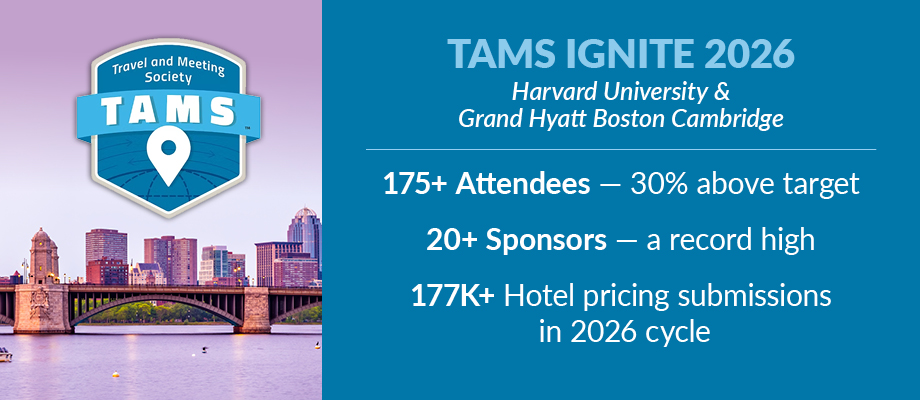
The centerpiece of Day 1 was a cross-functional working group that spent close to a year developing a framework to simplify hotel RFP processes using artificial intelligence. With more than 177,000 hotel pricing submissions in the 2026 cycle alone — and tens of thousands of rebids layered on top — the scale of complexity facing most programs today has outpaced the tools designed to manage it.
The group’s core argument: Corporate travel programs are still built around periodic decision cycles, but the environment now demands systems that continuously ingest data, evaluate options and improve over time. Expense auditing is moving closer to the point of transaction. RFP responses that once took days are being generated in hours. Data previously scattered across TMC, card and expense systems is converging into unified environments capable of driving real decisions. The net effect changes not just how decisions are made — but who makes them.
The session featured contributions from Takeda, Navan Travel, Akamai Technologies, Davidson Hospitality Group, Harvard University, Marriott International, FCM Travel, Cerebri AI and Iris AI, among others. Perhaps most notably, a student team from UC Irvine delivered a working AI prototype that became one of the most talked-about moments of the event — a demonstration that fresh academic perspectives can accelerate industry problem-solving.

Day One · Meetings & Payments
The Cost of Partial Alignment
Two afternoon panels addressed the persistent gap between intention and execution in enterprise travel programs. The meetings panel — featuring Groupize.ai, CK Consulting and Nowadays — made the case that fragmented ownership between travel and meetings functions creates measurable financial leakage. Tighter integration across sourcing, policy and technology is not a nice-to-have, it is a prerequisite for unlocking full enterprise value.
The payments panel, featuring voices from Clarasight, Visa and Citi, reinforced a complementary point: virtual payment infrastructure enables real-time visibility across travel spend. When payment, booking and expense data are integrated, organizations can move from reactive reporting to proactive program management — reducing both leakage and compliance risk in the process.

Day Two · Distribution & Demographics
What Is Changing Beneath the Surface
Day 2 opened with a fireside conversation moderated by Jay Campbell of The Company Dime, featuring Michael Qualantone and Kevin O’Malley of New M.O. The discussion moved past familiar headlines to examine structural shifts: distribution models evolving, technology stacks being rebuilt and the traditional boundaries between booking, payment and expense beginning to collapse. Questions of profitability among newer market entrants were raised directly.
Tim Hines followed with a keynote framed around attention as a finite and earned resource. His model — hook, hold and harvest — offered a practical framework for leaders navigating fragmented communication environments and set the stage for a session-day theme around relevance, trust and generational differences in how information is consumed and acted upon.

Day Two · Industry Responsibility
Human Trafficking Awareness: A Professional Standard, Not a Checkbox
One of the most substantive sessions addressed human trafficking awareness. Led by experts from PACT alongside TAMS leadership, attendees moved through real-world scenarios, learned warning signs specific to the travel industry and completed a certification assessment at the close of the session. The message was clear: this is an area where travel professionals occupy a unique position of visibility, and with that visibility comes responsibility. Corporate Travel Management reinforced its organizational commitment to the cause as a sponsoring partner.

Day Two · Breakouts
From Concept to Application
Three parallel immersive sessions closed the program, each designed to move from concept to execution. The first examined communication and attention in distracted workplace environments. The second tackled accessibility as a core design principle in corporate travel — not a compliance afterthought — with contributions from RTX, Wings for All, Delta Air Lines and others. The third explored how organizations can better develop the next generation of travel professionals, with a focus on connecting academic pathways to real-world application.
The Informed Travel Professional Has the Advantage
The topics covered at Ignite 2026 reflect where the industry is heading and staying current on them is one of the most valuable investments you can make in your program. We encourage you to dig deeper into the topics most relevant to your organization:
- How AI is reshaping hotel procurement and RFP management
- Virtual payments and real-time spend visibility
- Aligning travel and meetings programs to eliminate leakage
- Consolidating TMC, card and expense data into actionable insights
- Human trafficking awareness and your role as a travel professional
Your Business Travel Center of Excellence partner is a resource as you navigate these conversations. We share these updates because an informed travel professional builds stronger programs and stronger partnerships.
Learn more about this featured business travel agency near you
For more details, connect with this friendly, knowledgeable travel agency today.